龍德館

Yizong · The Moral Dragon · Bath, UK

Xingyiquan FAQ

Answers about Hebei Xingyiquan — five elements, twelve animals, lineage, and booking lessons at The Moral Dragon in Bath.

About Xingyiquan

What is Xingyiquan?

Xingyiquan (形意拳), or “Form and Intention Boxing,” is one of the three great internal kung fu systems, alongside Baguazhang and Taijiquan. It unites mind and movement into one focused expression. The movements look simple and direct, yet within them lie deep principles of structure, intent, and internal power.

Easy to begin but endlessly challenging to master, Xingyiquan builds strength, clarity, and resilience — qualities that grow both in practice and in life.

What is Hebei Xingyiquan?

At The Moral Dragon we teach traditional Hebei Xingyiquan as passed down through the Yizong lineage from master Luo Dexiu (羅德修).

Hebei Xingyi is characterised by aggressive, linear movement and explosive whole-body power. The work is concise — straight in and straight out — with calm, steady power used to develop awareness and qi. Single drills are the fundamental method of practice and the means of execution. Read the full overview on our Xingyiquan page.

What does “internal” mean for Xingyi?

Here “internal” means training that develops structure, timing, relaxation under pressure, and whole-body power — not floppy forms or vague energy talk. Breath, posture, and intent matter because they change how you move and fight.

Xingyi still sweats and hits hard in training. Explosive issuing power (fajing) sits at the core: coordinated whole-body movement generating bursts of force. The tradition of a skilled master is to defeat a challenger skilfully without leaving them seriously injured.

How does Xingyi differ from Baguazhang?

Both are internal arts in the Yizong curriculum, but they feel very different. Xingyi is linear, direct, and drill-heavy — five element fists, animal shapes, standing, and issuing power. Gao-style Baguazhang centres on circle walking, palm changes, and Pre-/Post-Heaven material.

Many students train both over time. The weekly Monday group class is Baguazhang; Xingyi is taught by booking dedicated lessons or private tuition.

How does Xingyi relate to Taijiquan at this school?

The Moral Dragon teaches the three internal arts of the Yizong curriculum: Hebei Xingyiquan, Gao-style Baguazhang, and Chen Panling Taijiquan. They share body-method ideas but differ sharply in rhythm and expression.

Xingyi emphasises straight-line drills and explosive power; Taiji in this line follows Chen Panling’s Nanjing 99 form with silk-reeling, push hands, and martial application.

Syllabus & training methods

What is in the Xingyi syllabus?

The Yizong Xingyiquan curriculum taught at The Moral Dragon includes basic hand methods, the five elements, twelve animals, linking forms, weapons-related training methods, and the body skills of fajin and stepping.

Xingyiquan employs the five elemental fists — Pi (chopping), Zuan (drilling), Beng (crushing), Pao (cannon pounding), and Heng (crossing) — together with Twelve Shape Fist as its basic fist methods. In standing practice it uses the Three Bodies Posture (santishi) as its foundation.

What are the five element fists?

The five element movements are regarded as the mother fists from which the rest of the system grows:

  • Chopping (劈, ) — Metal — chopping forward and over, downwards like an axe
  • Drilling (鑽, Zuān) — Water — drilling forward and upwards diagonally
  • Crushing (崩, Bēng) — Wood — striking out to the front, like an arrow
  • Exploding (炮, Pào) — Fire — exploding outward like a cannon
  • Crossing (橫, Héng) — Earth — crossing across the line of attack while turning over

Single and repetitive drill practice of these fists is central to Hebei Xingyi training.

What are the twelve animals?

From Five Element Fist, the twelve shapes evolve. A practitioner takes on the special characteristics of twelve animals — resembling shape and taking consciousness — and turns those skills into human fighting ability:

  • Dragon — contract the skeleton
  • Tiger — spring upon prey
  • Monkey — climb and seize
  • Horse — churning, fast hooves
  • Alligator — swim and float
  • Rooster — competitive fighting nature
  • Sparrow hawk — pierce through
  • Swallow — skim over water
  • Snake — move grass aside
  • Eagle — seize
  • Bear — shake and pull out
  • Vulture (Tai Bird) — striking and ramming

What is San Ti Shi (Three Bodies Posture)?

San Ti Shi (三體式), the Three Bodies Posture, is the foundation of Xingyi standing practice. It trains structure, root, and intent before and alongside the fist drills.

Hong Yixiang is often quoted along the lines of: hold santishi for an hour a day and you will discover how to improve your qi. Long standing practice can produce profound breakthroughs in mind and body — even if few people manage a full hour every day.

What is fajing / issuing power in Xingyi?

Fajing (發勁), issuing power, is explosive whole-body force generated from relaxed, coordinated structure — not arm-only muscle. Xingyi has excellent issuing-power drills that help you get connected and deliver that all-important whole-body strike.

It sits at the core of how Hebei Xingyi expresses power in fighting application.

Does Xingyi include weapons?

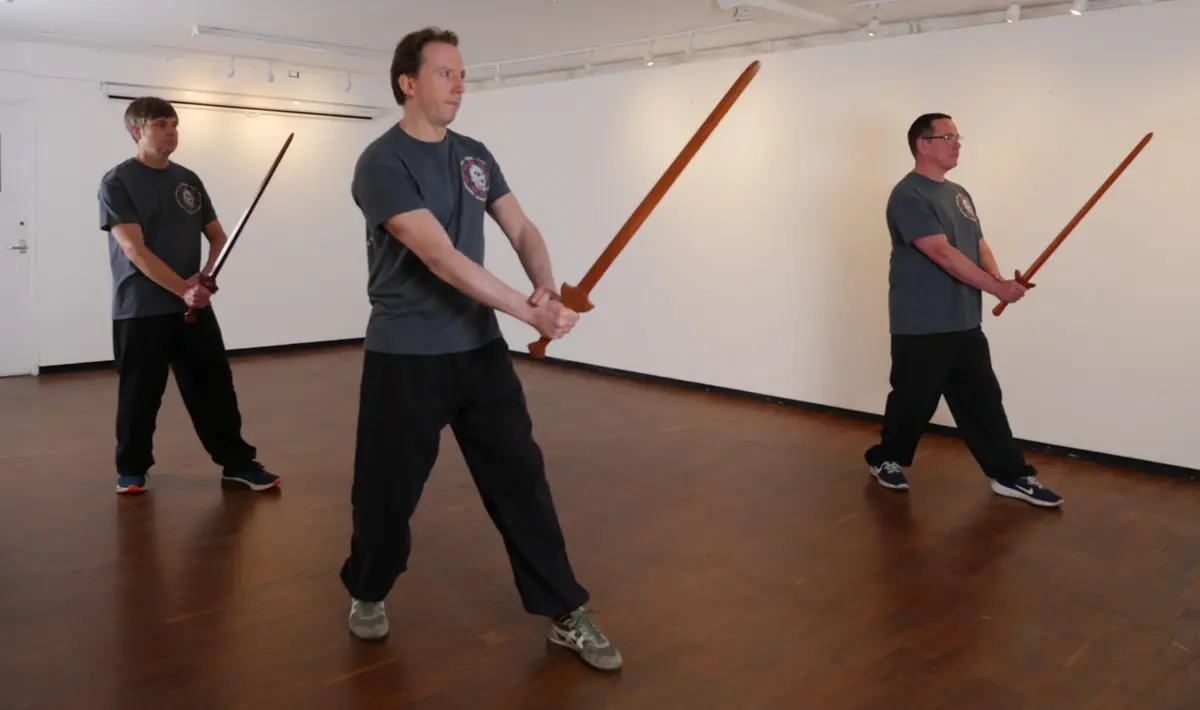
Yes. The Yizong curriculum includes weapons-related training methods alongside empty-hand work. Sword practice is part of how structure, intent, and whole-body power are refined. Weapons are introduced when a student has enough foundation in standing and fist methods — not as a beginner bolt-on.

How is Xingyi trained at The Moral Dragon?

Dedicated Xingyi lessons cover standing practice, five element drills, animal forms, issuing power, stepping, and fighting application. Groups are small; correction is direct. Progress follows ability, not grades or belts.

Whether you are new to martial arts or bringing experience from another system, the requirement is the same: patience, consistency, and a willingness to work.

History & lineage

Where does Xingyiquan come from?

Xingyi honours Yue Fei as the legendary founder of its school; its historical origin can be traced to Ji Jike (Ji Longfeng) of Shanxi in the early Qing dynasty.

Li Luoneng developed the popular style of Xingyiquan from Shanxi Dai-clan Xinyiquan, emphasising both “external structure” and “internal awareness” — form and manifestation of awareness. Descendants are divided among Henan, Shanxi, Hebei, and other lines under names including Xinyi Liuhe, Xinyiquan, and Xingyiquan.

A fuller account (by Luo Dexiu) is on the Xingyiquan history section.

What is the Yizong lineage for Xingyi?

Yizong (易宗) is the lineage created by Gao Yisheng (高義盛). It was passed on through Zhang JunFeng, the Hong brothers (Hong Yixiang, Hong Yimian, and Hong Yiwen), master Luo Dexiu, and Ollie Smith (龍德館) in Bath.

Hebei Xingyiquan is taught here as part of that Yizong curriculum alongside Gao-style Baguazhang and Chen Panling Taijiquan. Read more on the Yizong lineage page and the profile of Luo Dexiu.
Who teaches Xingyi at The Moral Dragon?

Ollie Smith teaches Hebei Xingyiquan (and the wider Yizong curriculum) in Bath under the Moral Dragon / 龍德館 name. Lessons are small-group or private, with hands-on correction — not a crowded drop-in gym model.

More background is on the About page.

Lessons, fees & joining

Is there a weekly Xingyi group class?

There is currently no dedicated weekly Xingyiquan group class. Monday evenings in Bath are Gao-style Baguazhang. Xingyi is taught by booking dedicated lessons or private tuition.

If you want dedicated Xingyi training in Bath, say so when you get in touch.

How do I start learning Xingyi?

Send a short message via the contact form or email ollie@themoraldragon.co.uk. Mention that you want Xingyiquan lessons, any martial arts background, and any injuries we should know about.

We aim to reply within a few days and can arrange a suitable time for private or small-group tuition.

How much does Xingyi tuition cost?

Private tuition is £45 per hour, paid in advance, available for Xingyiquan and Baguazhang.

The Monday Baguazhang group class (if you also train Bagua) is £15 for a trial and £40 per month thereafter — see Classes for full details. Xingyi itself is arranged by booking rather than that weekly membership.

Do you offer private Xingyi lessons?

Yes — private tuition is £45 per hour for Xingyiquan (and Baguazhang), paid in advance. This suits people with awkward schedules, those who want faster technical feedback, or students working on specific material such as five elements, animals, or fajing.

Enquire to arrange a time.

Can I train Xingyi and Bagua together?

Yes. Many students eventually work both arts. The Monday class covers Gao-style Baguazhang; Xingyi is added through booked lessons. Tell us your aims when you enquire so we can suggest a sensible starting path.

Do you teach Xingyi online?

The core offering is in-person training in Bath. Xingyi depends on feeling structure, timing, and correction in the room. If you cannot attend in person, ask about whether any arrangement is possible — but expect the standard path to be on the mat, not on a screen.

Where are Xingyi lessons held?

Training is in Bath at 19A Monmouth Place, Bath BA1 2AY. Car parking is available on site. See Contact for maps and details.

Beginners, fitness & training culture

Can absolute beginners learn Xingyi?

Yes. Whether you are new to martial arts or coming from another system, you are welcome. Xingyi rewards patience and consistency. You will start with fundamentals — standing, basic hands, and early five element work — and build from there.

How fit do I need to be?

You do not need to be an athlete to start. Intensity builds over time. If you have injuries or medical limits, tell the instructor before training so work can be adjusted sensibly.

Consistent practice improves fitness; you do not need to “get fit first” and then join.

Is there sparring or Sanda?

You will not find regular free sparring or Sanda training here. Fighting methods are practised, but applications are generally controlled and cooperative. The aim is clear technique, timing, and structure — not weekly hard sparring culture.

Are there belts or gradings?

No coloured-belt grading system. Progress is shown in what you can do: standing, five elements, animals, issuing power, stepping, and partner work. Traditional Chinese internal schools measure skill by practice, not by a belt ladder.

How long does it take to learn Xingyi?

There is no finish line. Useful fundamentals can appear in months; a deep grasp of five elements, animals, and issuing power takes years of steady practice. Show up, drill, stand, and keep refining.

Speed of progress depends on attendance, attention, and how you practise between lessons.

What should I wear?

Comfortable training clothes you can move and squat in — track bottoms or martial arts trousers, a T-shirt, and flat-soled indoor training shoes or socks as directed for the space. Avoid jeans, restrictive fashion wear, and outdoor muddy shoes on the training floor.

A traditional training uniform is fine if you have one; it is not required for your first lesson.

What should I bring to my first lesson?

Water, training clothes, and an open mind. If you wear glasses, consider a strap. Leave jewellery that can catch or scratch at home. No special equipment is required to start.

Location & practical details

Is there parking?

Yes — car parking is available on site at the Monmouth Place location. See Contact for the full address and map links.

Do you only teach in Bath?

The Moral Dragon’s regular training address is in Bath, Somerset. People sometimes travel from nearby towns; if you are further afield, contact us about whether booked Xingyi lessons can work for you.