龍德館

Yizong · Bath, UK

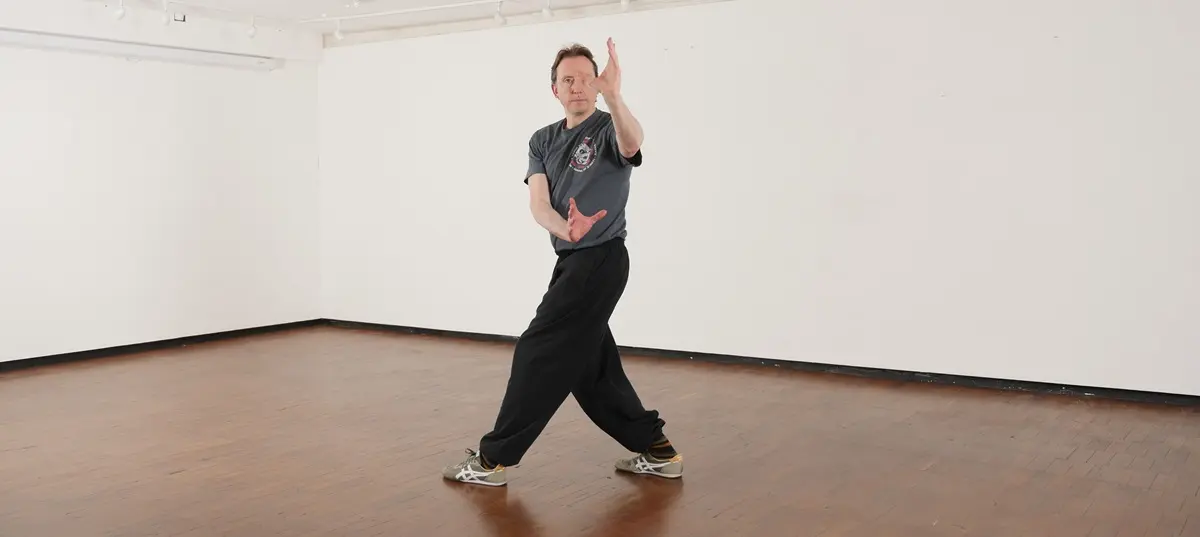
About The Moral Dragon

Learn about our lineage, training philosophy, and instructor Ollie Smith in Bath, Somerset.

What's with the name? Why The Moral Dragon?

The kung fu taught at The Moral Dragon is Gao-style Baguazhang and Hebei Xingyiquan and Chen Panling Taiji. Lessons are taught in person in Bath, following the Taiwan Yizong lineage from Master Luo Dexiu.
Our lineage

We trace a direct line of masters from the origins of Baguazhang through the Taiwan Yizong school — from Dong Haichuan to Cheng Tinghua, then Gao Yisheng (founder of Gao-style Baguazhang), Zhang JunFeng, the Hong brothers (Hong Yixiang, Hong Yimian, and Hong Yiwen), Luo Dexiu, and Ollie Smith (龍德館). Read the full Yizong lineage →

Ollie Smith is Yizong-certified and a senior student of Kung Fu Master Luo De Xiu of Taiwan.

In 2010 I left Taiwan after 8 years of training Internal Kung Fu with my teacher and some impressive classmates for a new life in Japan. Setting up to teach kung fu there proved very difficult and the local community centre said that I would need official certification of my right to teach. I contacted Luo for help and he mailed me a teacher’s certification with his stamp; my given school name was Long De Guan (龍德館). Breaking it down:

  • (lóng) — dragon
  • () — virtue, morality, goodness
  • (guǎn) — hall, building, pavilion, academy, or establishment (depending on context)
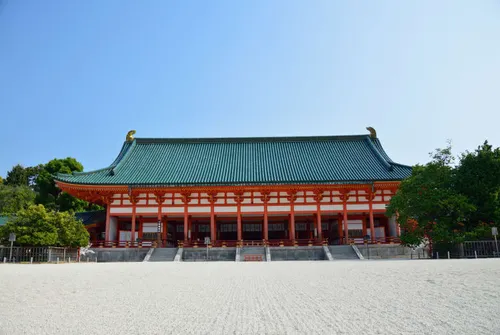
Heian Shrine in Kyoto, Japan
Heian Shrine, Kyoto — where Ollie taught kung fu outdoors for two years.

While the certificate was impressive to the Japanese officials, my Japanese was not and I was rejected. From that day on I taught in all weather in front of the Heian Shrine in Kyoto for two years straight.

The name of my school just remained Long De Guan, and I never tried to adapt it. One day a student asked me what my school name meant and I said something like “The Moral Dragon”, so that was the first time I had the idea to call my school ‘The Moral Dragon’.

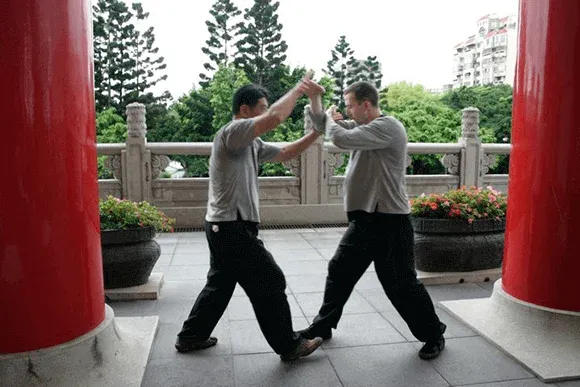
Master Luo Dexiu and Ollie Smith pushing hands at CKS Park, 2010
Master Luo Dexiu and Ollie Smith in 2010 at CKS Park Pushing Hands.

How we train

Training philosophy

The Moral Dragon follows traditional training as it was taught to our teacher. That means a very practical approach — you won't find too much discussion on esoteric aspects of internal kung fu. Be prepared for physically demanding exercise.

Internal kung fu doesn't mean standing about daydreaming about generating Qi. It means developing whole-body power, structure, and fighting application through consistent, focused practice.

My kung fu story

My interest in kung fu started as a young boy sitting in front of the TV, watching the hit 1970s cult classic Japanese television show Monkey Magic. I didn’t know at the time, but the show was based on the classic Chinese novel The Journey to the West.

Promotional still from Monkey (Monkey Magic) showing Tripitaka, Monkey, Sandy, and Pigsy with the show title
Monkey (known as Monkey Magic) — the 1978–80 Japanese TV series that first sparked an interest in kung fu.

I never had anyone trying to convince me to join in with kung fu, and I naturally moved towards martial arts. After a very brief introduction to Karate as a teenager, I found Western boxing and preferred the approach to learning fighting skills. The training was fantastic, and I quickly got to grips with the coordination, movement and timing of boxing. In the boxing gym, I learnt an important lesson the hard way. You should never feel pressured to fight someone stronger, heavier, more experienced and skilled than you, and you have to be very careful who you choose to spar with and trust. Yes, I got hurt and subsequently quit boxing altogether.

As good as boxing was, I needed an alternative strategy to help make up for my inferior physical strength and lack of ability to develop it; that’s when I began learning and a daily training regime of Shaolin kung fu. Tens of thousands of kicks later I felt that I had learnt enough from Wushu and without a stick in my hand and a sword in my belt I looked to invest some of my time in other things, like trying not to be single, making art and preparing for university.

Fast forward three years.

So, back to martial arts — I could box, move, kick and jump, my coordination was good, and I felt confident when sparring. I wasn’t quite 23 years old and moved back home after graduating from university. Whilst settling back into life in Kent I found Internal Kung Fu.

An old kung fu acquaintance of mine from my Shaolin days had started a Xingyiquan class which I began to attend regularly. Initially training kung fu again sparked my interest to learn more about fighting, and I followed my new teacher to various martial arts instructors throughout the UK for dedicated practice on everything to do with scrapping. We sparred regularly, and I learnt the tit-for-tat trade-offs of fighting people that knew about boxing. It was clear to me that something else was needed from the training but missing from the Xingyi fighting drills that I was being taught at the time; I needed to learn how to use kung fu.

Spending more and more time training Hebei Xingyi I quickly saw the potential in Xingyiquan forms, such as Five Element Kung Fu and 12 Animals and how they could be incorporated into fighting application. Around that time, I learnt of the famous BBC documentary on Internal Kung Fu called Way of the Warrior; for the first time, I was learning about maintaining structure and using whole body power. I learnt about Qigong and breathing. Xingyiquan opened my mind to new possibilities about training kung fu and training kung fu for life and not just to become a better fighter or learn how to defend myself. Kung fu would eventually become more about a life choice than anything else.

After training Xingyi Quan for many months, I met my teacher’s instructor, Bill Tucker — a senior student of Luo De Xiu who, at that time, was already a very well-respected martial arts fighter and teacher of Internal Kung Fu based in Taiwan. He had also featured in the BBC documentary Way of the Warrior that I mentioned earlier. That is when I looked closer at his lineage, named Yizong, and learned of his teachers and the Gao Yisheng line of Bagua Zhang.

It turned out that I had met Tucker before at my university, the year prior. I was intrigued by his Xingyi class advertisement that I saw in a local chip shop in Farnham. The ad caught my attention because it stated that Tucker had lived and trained with some of the most respected kung fu teachers in Taiwan. I had worked in Taiwan for a summer, just the year before that. So, I went along to meet him and watch a lesson. Meeting up with Tucker again, two years later and many miles away from Farnham, felt surreal. I soon regretted not joining his class sooner because he was an excellent internal kung fu teacher, with authentic traditional kung fu training methods.

After a year of Xingyi in the UK, Master Luo came to teach a seminar in Canterbury, Kent. At that time, I had already decided to try to find a job in Taiwan after a disastrous time not finding work in the UK.

It turned out the kung fu seminar with Luo De Xiu was great, and he turned out to be the real deal — a genuine no-nonsense kung fu master.

At the end of that first seminar with Luo he gave me a few instructions as to how I could find his class in Taipei — “go to the park at night and walk around until you see some foreigners practising kung fu.”

Fast-forward to Taipei in the middle of the incredible summer heat of 2000. I walked around the impressive CKS Memorial Park and stumbled upon a group practising Bagua. I introduced myself and my handwritten note from Luo Laoshi and started my kung fu training, which would take over my life for the next eight years.

Looking back, I can honestly say there were many ups and downs. Class dynamics were complicated, as they sometimes are with large martial arts schools. There were good players and bad players — not too bad, just no good. Luo didn’t get involved and was only concerned with teaching the internal kung fu material.

When it came time to leave, I was very worried and nervous about my move to Japan. In my last lesson with Luo, he beat me up all night, ending with a take-down onto the very rough floor in front of the CKS concert hall; it was like his last chance to get his experience through to me and also a reminder who the boss was. After the lesson, we all met in a bar for drinks, and at the end of the night, a handshake from Luo and then he was gone. I wouldn’t see or train with him again for two years.

Since 2010, I’ve been training with Master Luo every year, either meeting him in seminars throughout Europe or visiting Taiwan for four weeks at a time, at least once per year. As of July 2026, the last time I spoke to my teacher Luo Laoshi, he was as animated and enthusiastic about kung fu as he ever was.

Chiang Kai-shek Memorial Hall in Taipei, Taiwan
Chiang Kai-shek Memorial Hall, Taipei — where Ollie found Luo's class in the park.

My Exodus to a new life in Taiwan

Taiwan bound, the airplane was landing at Hong Kong International Airport and made the softest landing I’ve ever experienced on a flight. Everyone onboard the plane cheered. In retrospect it must have been a good sign leading up to my kung fu adventure in Taiwan. It was the summer of 2000 and the start of a new life.

I already decided that I would stay in Taiwan for at least five years and get as much kung fu as I could. I found Luo’s class at Chiang Kai Shek Memorial Park in Taipei and slowly got into training with Luo. By 2003 I was training all the time. I had almost no social life and all my friends apart from one or two were already training with Luo or had come along to the class. Kung Fu had taken over my life and it wasn’t all that bad. Luo’s main classes were Bagua and as I already knew some Xingyi so he slowly taught me extra forms and techniques within the Bagua lessons. Next I took an interest in Xingyi sword and regularly took a practice sword which he would inevitably take from me and show me new stuff, or take my sword and shove an umbrella in my hand then make me spar with him. You can imagine the outcome; some very painful lessons learnt.

Luo later started up a dedicated Xingyi class on Saturday and Sunday mornings which he did not always show up for. However it didn’t matter if he didn’t show as I had so much to work on. By 2005–6 I had learnt most of the Bagua and Xingyi systems. I had been taught Taiji principles but for some unknown reason we had only been taught the first section of the Chen Pan Ling Taiji form (Nanjing 99 form of Taijiquan). We had practised a lot of Si Ping Tui Shou for years in fact, as well as vertical and horizontal drills. Taijiquan was never attractive to me and so even today much of my time is taken up with Xingyi and Bagua and I still don’t have much of a hankering for Taiji.

Around 2006 I was constantly tasked by Luo to teach new students. This was frustrating as I felt that I still had not learnt everything and could use the time working with my peers more. I even noticed people who had joined the class long after me had learnt things that I hadn’t. Many years later sitting with Luo on a park bench in the UK I reminded him that I hadn’t got one of the Xingyi forms, to which he smiled and said quite jovially “do you think I’ll teach you everything?” I just laughed with him.

I trained Internal Kung Fu in Taiwan pretty much full-time till 2008. In those eight years I dedicated myself solely to Luo’s teachings as I still do. I left Taiwan and moved to Japan and continued training and teaching in the parks of Kyoto for two years before returning to Taiwan for a brief stay on my way back to the UK. I started teaching Internal Kung Fu in the UK in 2010 and have been back to Taiwan every year since then to catch up with Luo. When I’m not attending seminars in London, Germany and France I look forward to at least three weeks a year in Taiwan developing my kung fu knowledge and skill.

A very kung fu journey

It has been a profound journey so far, a truly great experience and privilege to learn kung fu closely from my teacher Master Luo De Xiu.