龍德館

Yizong · The Moral Dragon · Bath, UK

Gao Bagua FAQ

Answers about Gao-style Baguazhang, Pre-Heaven and Post-Heaven training, lineage, and joining classes at The Moral Dragon in Bath.

About Gao-style Baguazhang

What is Baguazhang?

Baguazhang (八卦掌, “eight trigram palm”) is one of the three great internal Chinese martial arts, alongside Xingyiquan and Taijiquan. The name refers to the eight trigrams of the I Ching. Training centres on change — controlling mind and body so you can move, turn, and strike while an opponent who cannot adapt falls behind.

At The Moral Dragon we teach Gao-style Baguazhang as a complete martial system: circle walking, palm changes, linear fighting forms, partner work, and body method — not stage performance or mysticism for its own sake.

What is Gao-style Baguazhang?

Gao-style Baguazhang (高氏八卦掌) was organised by Gao Yisheng (高義盛, 1866–1951), a master of the Cheng Tinghua branch of Bagua. He arranged Cheng-style material into a clear, extensive syllabus now practised worldwide — especially in Tianjin, Taiwan, and among serious students in the West.

Gao style is known for its clear split into Pre-Heaven (circle walking and palm changes) and Post-Heaven (sixty-four linear palms), plus line work, weapons, and supplemental training. Read the full overview on our Gao-style Baguazhang page.

What does “internal” kung fu mean here?

In this school, “internal” means training that develops structure, timing, relaxation under pressure, and whole-body power — not floppy forms or vague energy talk. Breath, posture, and intent matter because they change how you move and fight.

You still sweat, condition, and practise applications. The work is martial and physical; the method is precise rather than purely athletic.

How does Gao style differ from other Baguazhang styles?

All authentic Bagua shares circle walking and change. Gao style is distinctive for how systematically it pairs Pre-Heaven (round, continuous circle work) with a large Post-Heaven set of sixty-four linear fighting palms in eight lines, plus strong line-stepping methods that often feel close to Xingyiquan.

Different lineages emphasise different frames, weapons, and teaching orders. Ours follows the Taiwan Yizong transmission of Gao material through Zhang JunFeng, the Hong brothers, and Luo Dexiu.

How does Bagua relate to Xingyiquan and Taijiquan at this school?

The Moral Dragon teaches the three internal arts of the Yizong curriculum: Gao-style Baguazhang, Hebei Xingyiquan, and Chen Panling Taijiquan. They share body method ideas but feel very different in practice.

The weekly public group class is Baguazhang. Xingyi can be taught within in-person lessons or private tuition; there is currently no dedicated group Xingyi class. Ask if you want a clearer path across the arts.

Pre-Heaven & Post-Heaven

What is Pre-Heaven Baguazhang?

Pre-Heaven (先天, xiantian) is the circle-walking half of Gao style: continuous walking on a circle with palm changes. It builds structure, stepping, spiralling power, and the body method that the rest of the system rests on.

Pre-Heaven is often described as externally round and internally square. See the full syllabus overview on the Pre-Heaven Baguazhang page.

What is Post-Heaven Baguazhang?

Post-Heaven (后天, houtian) is the linear fighting half: sixty-four palms practised in straight lines across eight lines. These forms train consecutive strikes, elbows, kicks, footwork, and animal-body methods that chain technique into technique.

Post-Heaven is often described as externally square and internally round. Details are on the Post-Heaven Baguazhang page.

Why train both Pre-Heaven and Post-Heaven?

They are complementary halves of one system. Circle work develops the engine — change, root, and spiral. Line work develops clear fighting sequences and pressure. With long practice the two unite: interception, entwining, hard and soft, empty and full become one responsive body.

Beginners usually start with foundational Pre-Heaven work (including circle walking and early palm changes) while gradually meeting Post-Heaven material as appropriate.

What is circle walking?

Circle walking is the signature practice of Baguazhang: walking a continuous circle while holding palm postures and changing direction with palm changes. It trains legs, waist, shoulders, and awareness together — not as separate drills.

It looks simple from outside and is demanding inside. Much of Gao Pre-Heaven skill is built on how you walk, turn, and change without losing structure.
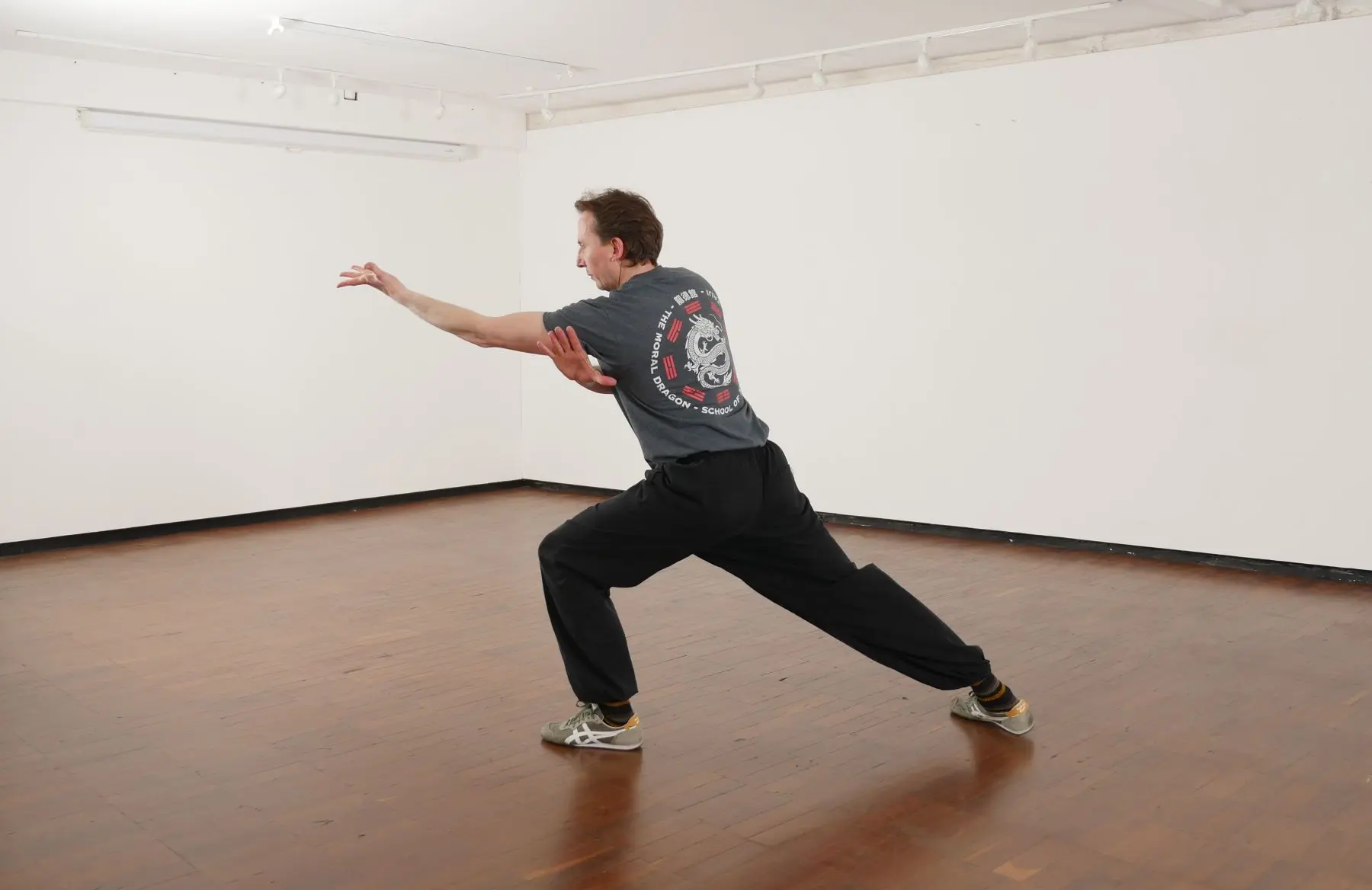
What is the single palm change?

The single palm change is a fundamental turning and changing method in Pre-Heaven Bagua. It teaches how to reverse direction on the circle while keeping power connected through the body — a gateway skill for the larger palm-change syllabus.

You will meet it early in training; refining it never really stops.

Does Gao Bagua include weapons?

Yes. Traditional Gao-style training includes weapons work as part of the wider curriculum (alongside empty-hand palms, conditioning, and partner practice). Weapons are introduced when a student has enough structure and timing in the empty-hand work — not as a separate “weapons class” bolted on for beginners.

Ask in class or by enquiry if you have prior weapons experience and want guidance on where it fits.

Lineage & teachers

What is the Yizong lineage?

Yizong (易宗) is the lineage created by Gao Yisheng (高義盛), founder of Gao-style Baguazhang. It was passed on through Zhang JunFeng, the Hong brothers (Hong Yixiang, Hong Yimian, and Hong Yiwen), master Luo Dexiu, and Ollie Smith (龍德館) in Bath — where we teach Gao-style Baguazhang, Hebei Xingyiquan, and Chen Panling Taijiquan from this line.

Read the full story on the Yizong lineage page and the profile of Luo Dexiu.

Who teaches at The Moral Dragon?

Classes are taught by Ollie Smith, who trains and teaches Gao-style Baguazhang (and the wider Yizong curriculum) in Bath under the Moral Dragon / 龍德館 name. Training is small-group and hands-on — direct correction, not a crowded drop-in gym model.

More background is on the About page.

What does “The Moral Dragon” mean?

The Moral Dragon is the English name of the school; the Chinese name is 龍德館. It marks this Bath school within the wider Yizong family of teachers and students — not a franchise brand or a generic kung fu club name.

Classes, fees & joining

When and where are classes?

Weekly group Baguazhang is Mondays, 6:30pm–8:30pm, in person in Bath at 19A Monmouth Place, Bath BA1 2AY. Car parking is available on site.

Full schedule and fees are on the Classes page. For maps and contact details, see Contact.

How much does it cost?

Group class (Mondays)

  • Trial lesson: £15
  • Monthly membership: £40, payable on the 1st of each month

Private tuition — £45 per hour, paid in advance, available for Baguazhang and Xingyiquan. Get in touch to arrange a time.

Can I try a class before joining?

Yes. The first lesson is a £15 trial. After that, regular students train on monthly membership. Please contact us before your first Monday so we know you are coming and can answer any questions.

How do I join?

Send a short message via the contact form or email ollie@themoraldragon.co.uk. Mention that you are interested in the Monday Baguazhang class (or private lessons), any martial arts background, and any injuries we should know about.

We aim to reply within a few days.

Do you offer private lessons?

Yes — private tuition is £45 per hour for Baguazhang and Xingyiquan, paid in advance. This suits people with awkward schedules, those who want faster technical feedback, or students working on specific material.

Enquire to arrange a time.

Is there a Xingyiquan group class?

There is currently no dedicated weekly Xingyiquan group class. Xingyi can be taught within in-person lessons and through private tuition. If you want dedicated Xingyi training in Bath, say so when you get in touch.

Do you teach online?

The core offering is in-person training in Bath. Internal kung fu depends on feeling structure, timing, and correction in the room. If you cannot attend Mondays, ask about private lessons or occasional arrangements — but expect the standard path to be on the mat, not on a screen.

Beginners, fitness & training culture

Can absolute beginners join?

Yes. Whether you are new to martial arts or coming from another system, you are welcome. Internal kung fu rewards patience and consistency more than raw athleticism. You will start with fundamentals and build from there.

How fit do I need to be?

You do not need to be an athlete to start. Classes include warm-up and conditioning, and intensity builds over time. If you have injuries or medical limits, tell the instructor before training so work can be adjusted sensibly.

Consistent practice improves fitness; you do not need to “get fit first” and then join.

Is there an age limit?

Adults of a wide age range train internal arts successfully when the work is scaled to the body in front of us. If you are unsure whether the class suits you, describe your situation when you enquire — honesty about knees, backs, and recovery helps more than guessing from a website.

Is there sparring or Sanda?

You will not find regular free sparring or Sanda training here. Fighting methods are practised, but applications are generally controlled and cooperative. The aim is clear technique, timing, and structure — not weekly hard sparring culture.

Are there belts or gradings?

No coloured-belt grading system. Progress is shown in what you can do: circle walking, palm changes, Post-Heaven lines, partner work, and understanding. Traditional Chinese internal schools measure skill by practice, not by a belt ladder.

How long does it take to learn Gao Bagua?

There is no finish line. You can learn useful fundamentals in months; a deep grasp of Pre-Heaven and Post-Heaven takes years of steady practice. Gao style is a large syllabus by design — that is a feature, not a sales pitch for endless beginner modules.

Show up, walk the circle, and keep refining. Speed of progress depends on attendance, attention, and how you practise between classes.

What happens in a typical class?

Expect a structured session with warm-up and conditioning, form practice (circle walking and/or palms), partner drills, and practical application where appropriate — following traditional syllabus progression in a small group with direct correction.

Details and ethos are summarised on the Classes page.

What should I wear?

Comfortable training clothes you can move and squat in — track bottoms or martial arts trousers, a T-shirt, and flat-soled indoor training shoes or socks as directed for the space. Avoid jeans, restrictive fashion wear, and outdoor muddy shoes on the training floor.

If you already own a traditional training uniform, that is fine; it is not required for your first class.

What should I bring to my first class?

Water, training clothes, and an open mind. If you wear glasses, consider a strap. Leave jewellery that can catch or scratch at home. No special equipment is required to start.

Location & practical details

Is there parking?

Yes — car parking is available on site at the Monmouth Place location. See Contact for the full address and map links.

Do you only teach in Bath?

The Moral Dragon’s regular public class and school address are in Bath, Somerset. People sometimes travel from nearby towns; if you are further afield, contact us about whether the Monday class or private lessons can work for you.