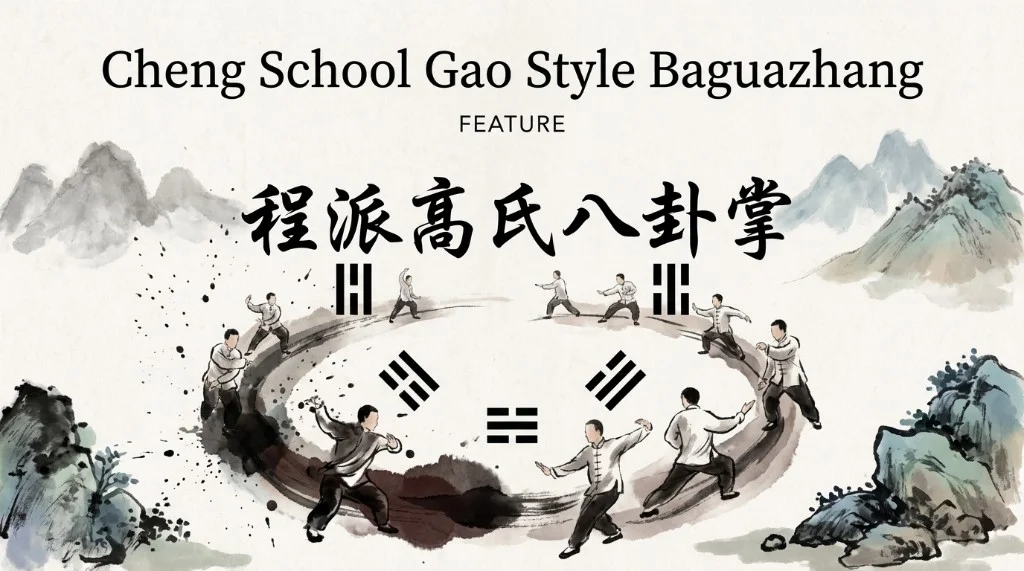
The historical roots of Baguazhang are a mix of oral history, named teachers, and later sorting. Among the branches, Cheng School Gao Style Baguazhang (程派高氏八卦掌) sits in a clear place. Gao Yisheng kept the circular work of Cheng Tinghua and set beside it a linear syllabus of sixty-four Post-Heaven palms.
The historical root: Dong Haichuan and Cheng Tinghua
The art traces to Dong Haichuan (董海川) in Beijing. Ask a Bagua player for Dong’s two best-known students and the usual answer is Yin Fu and Cheng Tinghua. Yin Fu stayed with Dong longest. He later served as the Empress Dowager’s head bodyguard when she left the Forbidden City in 1900.
It was Cheng Tinghua (程廷華, 1848–1900) who left the widest open transmission. He was born in the Cheng family village, Shen County, Hebei. As a young man he went to Beijing to apprentice with an eyeglass maker — hence “Eyeglasses Cheng.” In Beijing he trained Chinese wrestling (shuai jiao). Two wrestling styles were current: Manchurian/Mongolian wrestling, and Baoding (Pao Ting) “fast style,” which threw as soon as contact was made and mixed punches, kicks, and locks with the throws. Cheng practised both.
When he put that wrestling into Bagua, the work became close, twisting, and throwing. The basic palm of the Cheng branch is the dragon-claw palm, not Yin Fu’s ox-tongue palm. Luo Dexiu, speaking of the two palms in Taipei, said the names describe how they are used, not a claim that either man had only one shape. The later Cheng forms include the “swimming body, continuous and linked” set — swimming-body Bagua (游身, yóu shēn).
Cheng taught openly and took many students. He compared work with Xingyi friends Li Cunyi (Li Tsun-I) and Zhang Zhaodong (Chang Chao-Tung). In 1894 Cheng, Li, Liu Dekuan, and Liu Waixiang formed a brotherhood so that a student of one could train with the others. They treated Bagua, Xingyi, and Taiji as one family of Neijia. The later label “Wudang boxing” is a different, later story — not where these arts began.
Cheng was killed in 1900, when the Eight-Nation Alliance entered Beijing.
Gao Yisheng and the Gao syllabus
Gao Yisheng (高義盛, 1866–1951) is the fourth generation on the tree below: Dong, Cheng, Zhou Yuxiang (周玉祥, Chou Yu-Hsiang), then Gao.
Gao trained under Zhou, a senior Cheng student known for crashing palm (zhuangzhang, 撞掌). Zhou later presented him to Cheng, before Cheng’s death in 1900. Gao already had a strong base in Ta Hong Quan. The eight elbows and eight kicking sets in his system are usually traced to that earlier art.
In the 1936 foreword to his book Pa Kua Supple Body Continuous Palms, Gao wrote that between 1911 and 1918, while teaching in Ta Shan township, Shandong, a Daoist named Song Yiren (Sung I-Jen) taught him the sixty-four straight-line Post-Heaven palms. Dan Miller, following Kang GeWu’s research, does not treat that Daoist as historical. The usual reading in Gao’s own line is that the Post-Heaven 64 are Gao’s organisation of what Cheng and Zhou had already taught as applications, practised on a straight line in the Xingyi manner — one technique, repeated. He most likely worked that set out in Shandong between 1912 and 1918, when he was in his mid-forties.
Kang judged that at least half of Gao’s Post-Heaven techniques come straight from Zhou. Zhou’s favourite method was opening palm (kai zhang), which is the first of Gao’s sixty-four. The tai that Zhou used to drop Gao on their first meetings appears in Gao’s fourth line, palm three. Liu Fengcai printed Kang’s findings as the foreword to his own book.
So the Gao system is Cheng’s circle and swimming body, plus a linear fighting syllabus Gao wrote down.
Two streams: Tianjin and Taiwan (Yizong)
As the twentieth century went on, Gao’s teaching split by who stayed and who left.
Tianjin — Liu Fengcai and Liu Shuhang. Liu Fengcai (劉鳳彩, 1908–1987), Gao’s nephew, trained with Gao in Tianjin for years and kept the full Pre-Heaven and Post-Heaven syllabus there. Liu Shuhang (劉樹行) carried that Tianjin school on. The Tianjin line is known for structure, body method, and the complete set of palms.
Yizong / Taiwan — Zhang Junfeng and the Hong brothers. Zhang Junfeng (張俊峰, 1902–1974) studied with Gao in Tianjin, then left for Taiwan in 1948. Gao gave him the lineage name Yizong (易宗), “lineage of the Changes,” and the designation 臺始易宗. In 1950 Zhang opened the Yizong Martial Arts School in Taipei. His first group on Round Mountain included the three Hong brothers — Hong Yiwen, Hong Yixiang, and Hong Yimian. Luo Dexiu trained first to fight under Hong Yixiang, then took Bagua from Hong and from other Zhang students. Ollie Smith has been Luo’s student since 2000 and teaches the same Gao syllabus in Bath.
The weekly class at The Moral Dragon is this Yizong stream: Gao-style Baguazhang, with Xingyi available by booking.
Cheng-Gao lineage tree
The numbering here is a teaching map for this school, not a claim that every Bagua family counts generations the same way.
-
Dong Haichuan (董海川) — 1st generation, founder
-
Cheng Tinghua (程廷華) — 2nd generation, Cheng style
-
Zhou Yuxiang (周玉祥) — 3rd generation
-
Gao Yisheng (高義盛) — 4th generation, Gao style
-
Tianjin branch
-
Liu Fengcai (劉鳳彩) — 5th generation
- Liu Shuhang (劉樹行) — 6th generation
-
-
Yizong / Taiwan branch
-
Zhang Junfeng (張俊峰) — 5th generation, took Gao style to Taiwan
-
Hong brothers (Hong Yiwen, Hong Yixiang, Hong Yimian) — 6th generation
-
Luo Dexiu (羅德修) — 7th generation
- Ollie Smith — 8th generation
-
-
-
-
-
-
-
Sources
The Cheng Tinghua pages, the dragon-claw palm, Cheng’s death in 1900, the 1894 Neijia brotherhood, and the account of Gao’s Post-Heaven palms (Shandong, 1912–1918; the 1936 book; Zhou’s techniques inside the 64) follow:
- Dan Miller, “The Pa Kua Chang of Ch’eng T’ing-Hua,” Pa Kua Chang Journal Vol. 3 No. 2 (January/February 1993), including the section “Kao I-Sheng’s Pa Kua Chang.” Miller draws there on Kang GeWu’s research and on Gao’s 1936 foreword.
The Taiwan Yizong continuation — Zhang Junfeng, the Hong brothers, Luo Dexiu, and Ollie Smith.
Spellings here use the pinyin used elsewhere on the site (Cheng Tinghua, Dong Haichuan, Gao Yisheng, Zhou Yuxiang, Zhang Junfeng). The journal uses Wade–Giles (Ch’eng T’ing-Hua, Tung Hai-Ch’uan, Kao I-Sheng, Chou Yu-Hsiang, Chang Chun-Feng).
Further reading: Cheng Tinghua, Yizong lineage, Gao-style Baguazhang, Post-Heaven.